
· Write a descriptive piece called The Mountain. In your writing, create a sense of atmosphere, and focus on colors and sounds to help your reader imagine the scene. The Answer: (Descriptive Writing A-Level Example) The Mountain. It had been a long hard trek across the sludgy path, my footfalls producing rhythmic squelches + DESCRIPTIVE WORDS FOR WRITING. These descriptive words will help improve your blogger.com these describing words are from my own personal notes. I’m an avid, and active, reader, and over the last couple of years I’ve jotted down the descriptive Descriptive writing has a unique and appealing power, as it evokes visuals, smells, sounds, textures, and tastes. Applying the description in your writing brings the world within your text to your reader. Examples of Descriptive Paragraphs. Let’s examine the descriptive text with the help of a few examples described below
Types of Descriptive Writing | Learn English
Andrew Sedillo has taught Language Arts, Social Studies, and Technology at a middle school level. He currently holds a Bachelor's of Arts in Education, Master's of Arts Educational Learning Technology, and a Graduate certificate in Online Teaching and Learning.
Descriptive writing in english Blakeley has a Bachelor's in English Literature from McGill University and a TEFL certification. She has been teaching English in Canada and Taiwan for seven years. Take some time to think about the differences between a short and a long conversation that you've had with someone about a specific event. Chances are that the short conversation lacked details and got straight to the point.
The long conversation most descriptive writing in english had so much detail that you could almost picture yourself being there now. Or, think about getting directions from friends. If you were invited to a party, would you prefer the directions that just said, 'By the school,' or would you prefer detailed directions that provide specific streets? Description is an important part of daily life and has an even bigger role in writing. Descriptive writing is a literary device in which the author uses details to paint a picture with their words.
This process will provide readers with descriptions of people, places, objects, and events through the use of suitable details. The author will also use descriptive writing to create sensory details as a means of enhancing the reading experience. If done effectively, the reader will be able draw a connection through the use of sensory details that include seeing, hearing, smelling, touching, and tasting.
These techniques will assist you in becoming not only a better writer, descriptive writing in english, but will also make your writing more engaging for readers. As a member, you'll also get unlimited access to over 84, lessons in math, English, science, descriptive writing in english, history, and more. Plus, get practice tests, quizzes, and personalized coaching to help you succeed. Get unlimited access to over 84, lessons. Already registered? Log in here for access.
Log in or sign up to add this lesson to a Custom Course. Log in or Sign up. Here are some examples of descriptive writing techniques that you can utilize and effectively apply to your own writing, descriptive writing in english.
Choosing your focus: When you first begin writing, it's extremely important to decide what your topic is going to be. This will prevent you descriptive writing in english losing focus on the theme or main idea of your writing, descriptive writing in english. When you decide what you are going to write about, you can begin to add details descriptive writing in english the specific event, object, or person.
Use of words: In most cases, you'll use adjectives to make your writing more detailed for the reader, descriptive writing in english. For example, rather than just saying: 'The dog sniffs around,' you'd say: 'The big brown dog sniffed around the red rose bushes in the front yard.
This process will allow the reader to create a mental image through the use of your word choice. Reader interest: As a writer, it's important paint a picture with your words, descriptive writing in english. One of the best ways to do this is through the use of the five senses. This won't only descriptive writing in english your target audience, but it'll appeal to other readers as well.
By using taste, smell, hearing, sight, and touch, you are creating an opportunity for the reader to develop an emotional connection to your writing. Re-reading and redo: Re-reading what you write is an important step in the descriptive writing process. This gives you time to reflect on whether or not you need to add more details to your writing.
Putting yourself in the readers' position is important. Ask yourself after reading your writing, 'Would I be able to understand the main topic of my writing if I had no prior exposure? Always remember, good descriptive writing is done well if the main topic of your writing is understood by all readers.
Now, let's take a look at a few samples that show us the difference between writing that is descriptive and writing that isn't. I was nervous about my first day of school. My mother dropped me off in the front of descriptive writing in english school. I got out of the car, and heard the bell ring. I walked to class. I found my class, and sat down in the front.
My teacher walked in and yelled at me. I was nervous about my first day of high school. My mother dropped me off in the student drop-off zone located in front of the school.
I got out of the car, and I saw the principal standing greeting everyone walking around. The kids were all taller than me; some of the guys even had beards!
The first thing I wondered was how I would get around this huge school. I stood in the front looking for people that I knew to shake out the butterflies in my stomach. I walked around for a few minutes until I heard a loud ring; it was the school bell. Students began to rush inside; it was like a stampede of elephants. I followed the rest of the kids. The hallways smelled like a combination of sunscreen and cheap body spray. After five minutes of walking, I finally found my first class.
I walked in and found a seat in the front of the classroom. I sat next to descriptive writing in english girl who was descriptive writing in english a bright red sweater. She was annoyed because some of the kids were asking her why she was wearing a sweater during the summer.
She said it was because she loved the feeling of cashmere, descriptive writing in english, and it was her lucky red sweater.
I sat there for another two minutes staring around to see if I recognized anyone. I looked on my schedule, and, to my surprise, class did not start for another three minutes, and finally I pulled out a stick of Doublemint gum. Eventually the bell rang, descriptive writing in english. The teacher walked inside, and that's when things started to go badly for me. The teacher yelled at me at the top of his lungs, 'No gum! I was scared and nervous, but then the teacher smirked and said, 'Unless you have some for me!
Hopefully you see the difference! Descriptive writing is an important descriptive writing in english device. This allows the writer to create a connection with their readers through the use of details. There are several techniques a writer uses in their writing, such as word choice and sensory details to paint a picture with their words.
If done correctly, all readers will be able to understand subject matter they have no background knowledge of. Some tips for using effective descriptive writing include choosing your focus, use of words, reader interest, re-reading and redo. To unlock this lesson you must be a Study.
com Member. Create your account. This lesson explained to you how descriptive writing can change a short, under-developed piece of writing into a detailed and descriptive writing in english masterpiece.
Use the following activities to practice your new skills. One of the most useful things that writers can do is to read a lot, descriptive writing in english. This will expose them to various writing styles and help them develop their own voice. Take a look at some of the books that you've read recently.
See if you can find a descriptive passage in one or more of them. Read the passage carefully. Which senses does the passage evoke? Does the author make you feel like you're really in the scene, experiencing the action with the protagonists? Examples of books with strong descriptive passages: The Hunger Games by Suzanne Collins; Jane Eyre by Charlotte Brontë; The Great Gatsby by F.
Scott Fitzgerald; The Curious Incident of the Dog in the Night-Time by Mark Haddon. Just like the example given in this lesson, this activity will give you the opportunity to tell a story in two ways.
Think of something interesting that happened to you recently, or make up a new story from scratch. First, write the story with as few details as possible, just the bare bone facts. Read the story back and think about how it would sound to someone who didn't experience the real thing.
Now, rewrite the story using lots and lots of detail. Think about all five senses as you write. Include metaphors, similes, and other figurative language in your writing, descriptive writing in english.
Read the second version back and see the improvement! Don't forget to reread and edit your work to make it as good as it can be. Already a member? Log In. for Teachers for Schools for Working Scholars® for College Credit. Log in.
How to write a Descriptive Paragraph - Details
, time: 2:01Descriptive writing - Descriptive Writing - Higher English Revision - BBC Bitesize
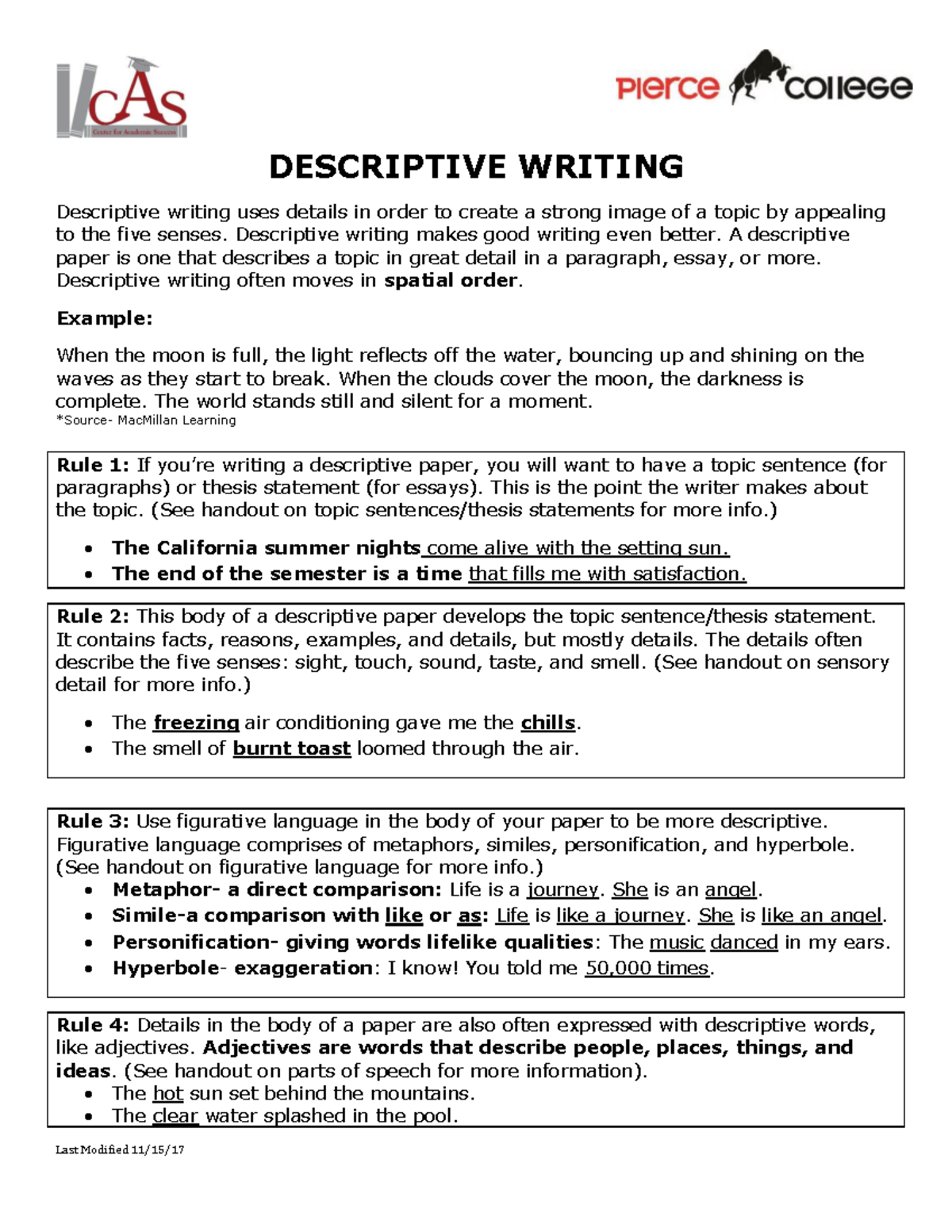
· Descriptive writing. Most forms of writing involve description. In a short story, characters and places need to feel real for the reader. Description of events, feelings and atmosphere helps to · Write a descriptive piece called The Mountain. In your writing, create a sense of atmosphere, and focus on colors and sounds to help your reader imagine the scene. The Answer: (Descriptive Writing A-Level Example) The Mountain. It had been a long hard trek across the sludgy path, my footfalls producing rhythmic squelches Types of Descriptive Writing | Learn English

No comments:
Post a Comment